Aging of Finished Cigars — How Temperature, Humidity, and Air Circulation Shape Flavor Evolution
In July 2021, Shanghai saw days of continuous rain. I put a freshly arrived box of Nicaraguan medium-full Robusto directly into the 50-slot electronic humidor in the living room. The hygrometer in the cabinet jumped to 74%, with a temperature of 26°C. On the third day the wrapper began to feel tacky, and on the fifth day a fine white frost appeared on the edge of the box — not "good oil," but mold. That week I was forced to break open the whole box, quarantine it, air it down to 65%, and then slowly return it to the cabinet. From then on, that batch always smoked with a damp, cardboard-like flavor, and the pepper and cocoa that should have been in the first draw never came back. Since that experience, my attitude toward "aging finished cigars" has become very concrete: not throwing cigars into a cabinet and waiting for a miracle, but using temperature, humidity, and air circulation to tune the chemical reactions that are still unfinished inside an already-rolled cigar to a speed and direction you can accept.
Let me break this down: what exactly keeps changing after a cigar is finished, which part temperature, humidity, and ventilation each control, and the pitfalls and numbers I have collected from real cabinets over the years.
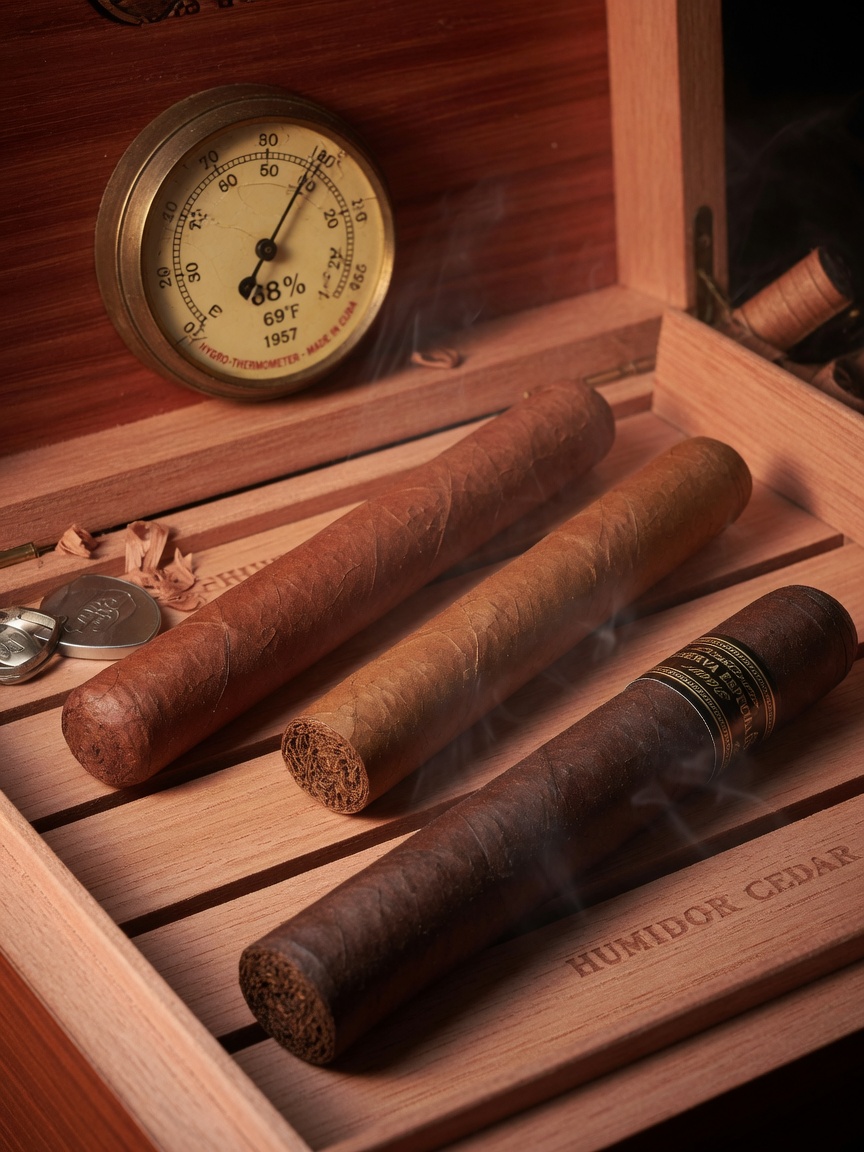
1. Aging a finished cigar is not a "second fermentation," but the chemistry has not stopped
Many people lump pile fermentation of tobacco leaves together with the rest / aging of finished cigars. The former happens in the factory or workshop, where leaves are piled into tall stacks and, driven by microbial and enzymatic reactions under relatively high temperature and humidity, ammonia, bitterness, and raw green notes are pressed down substantially while a batch of aroma precursors is generated; the latter is the slower, quieter change after the cigars are already rolled, even boxed and shipped, carried out in a relatively mild environment.
What still happens after rolling includes at least the following:
- Moisture rebalancing The filler, binder, and wrapper are not necessarily rolled at the same moisture content. The microclimate inside the box re-distributes moisture during transport. The "new cigar" you buy is often a cigar still seeking internal balance. That is why newly arrived cigars usually need to rest for weeks or months instead of being smoked the day the box is opened — not a ritual, but giving the moisture channel the uniformity needed for stable combustion.
- Emission of residual volatiles Pre-roll conditioning and rehumidification accelerate local reactions, but the finished product can still retain ammonia and irritating volatiles. The rule of thumb commonly cited in public references is: for most conventionally processed cigars, the ammonia note recedes substantially within a few months, drops to very low levels within about a year, and usually approaches disappearance after two years; mild cigars and small ring gauges tend to be faster. My own comparison is cruder: from the same box of Dominican Connecticut, on day 10 in the cabinet, a cold draw and nasal sniff still carried a clear "toilet ammonia" sensation; on day 90, only faint grain and wood remained. On the palate, the harshness in the first third and the numbing sensation on the tongue weakened in step.
- Migration of oils and aromatic components between structures A finished cigar is a "sandwich" of three (or more) layers of leaf. Over time, fat-soluble aroma substances diffuse slowly between filler, binder, and wrapper, and the boundaries become less rigid. The result: the "filler is filler, wrapper is wrapper" disconnectedness of a year ago becomes a single, more continuous smoke.
- Extremely slow oxidation and residual biochemical activity The higher the temperature and the higher the humidity, the faster the reactions. That is why people aging long-term deliberately keep conditions a little cooler and drier than "ready to smoke at any time" — not mysticism, but slowing the reactions down to avoid overshooting and infestations.
The factory side has actually been doing this for a long time: after rolling, a rest of at least 90 days is common, and some premium lines are held for six months or even longer before release. What you do at home is extending that curve and rewriting its slope according to your own cabinet conditions.
2. Temperature: the "gearbox" of aging, not a decorative parameter
1. Two common ranges — do not mix them up
Two sets of discourse have long coexisted in the industry:
- Aging-leaning / conservative: about 16–18°C, relative humidity about 65%. Some collector-oriented references clearly advise that conditions for long-term aging should be lower than everyday consumption conditions.
- Everyday-enjoyment-leaning: about 19–21°C (or 65–70°F), humidity about 65–70%. The classic "double 70" (70°F / 70% RH) mostly falls on this side.
My own division is practical:
| Use | Temperature target | Humidity target | Notes |
|---|---|---|---|
| "Everyday cabinet" smoked weekly | 20–21°C | 66–68% RH | Combustion-friendly; frequent opening does not dry it out easily |
| "Aging cabinet" for 1–5 years | 17–19°C | 63–66% RH | Slower, bug-deterring, slightly drier, fewer fluctuations |
| Absolute red line | sustained >25°C | sustained >75% or <60% | Beetles, mold, cracking, flavor collapse |
In the winter of 2022, Beijing's heating ran at full blast, and the surface of the living-room cabinet felt noticeably warm to the touch. Using an external probe to measure the air inside, it once surged to 24.5°C, and the humidity was "baked" down to a reading of 58%. Two weeks later, that batch of Honduran Maduro developed fine cracks in the wrapper, the cold draw turned dry, and the caramel sweetness became wood shavings. After rehumidifying to 65%, the structure partially recovered, but the black-chocolate depth of the middle third never returned. The damage that out-of-control temperature does to the oils is often irreversible.
2. Too hot: not "aging faster," but compounding risk
As the temperature rises, molecular motion accelerates and both volatilization and oxidation speed up. In the short term you may feel the cigars "ripen fast," but at the same time:
- Tobacco beetle eggs hatch and become active more easily (sustained highs are especially dangerous; public references often regard roughly 25°C and above as a serious risk zone);
- Aromas may be "flattened" or pushed into odd burnt bitterness;
- The structure loosens and the draw channel tends to collapse.
I have seen people place a cabinet beside a westward-facing window in summer; three months later a whole box was nothing but dust and beetle holes — that was not aging, that was destruction.
3. Too cold: time almost stands still
Sustained below about 15°C (some references mention even lower thresholds such as about 12°C), chemical processes slow down significantly. The cigars can be "preserved," but they will hardly "improve." If your goal is to enjoy a rounder version after three years, leaving cigars in an overly cold environment for a long time is like stopping the clock.
4. Fluctuation is worse than "slightly off"
A cigar is a porous hygroscopic body. If the temperature swings 5–8°C back and forth within a day, the relative humidity follows, the cigars repeatedly expand and contract, the wrapper micro-cracks, the burn drifts, and the draw channel becomes inconsistent. My rule of thumb: a steady-state 19°C / 66% beats a "nice-looking average" that jumps between 17–23°C and 62–72%. I hold my fluctuation tolerance at roughly ±1°C and ±3% RH before intervening; smaller jitters are left to the cabinet's buffering — do not turn the knob every day.
3. Humidity: decides whether you get "oil" or "ash," and whether it grows mold
1. High humidity: thick, mold-prone, dull burn
When humidity stays pinned above 70% for a long time, the smoke tends to be thicker and more "watery," which is sometimes a plus for people who like a full mouthfeel; but for long-term aging I increasingly avoid this path. The reasons are practical:
- The mold window widens (my 74% incident in Shanghai in 2021 is the lesson);
- The wrapper swells with absorbed moisture and breaks more easily;
- Ammonia and off-notes dissipate more slowly, dragging out the sick period;
- Combustion temperature runs low, easy to go out, and ash fails to hold shape.
Many long-term agers push their target down to around 65%, or even 62–65%, trading slight dryness for stability and safety. Boveda and similar two-way humidification packs commonly come in 65% and 69% grades, precisely products built on the "don't get too wet" consensus.
2. Low humidity: cracking and aroma collapse
Sustained below about 60%, moisture and volatile oils are lost together. Wrappers become brittle and crack; the smoke is dry, sharp, and short. Worse still: after going dry and then rehumidifying, the structure can partially recover, but the flavor rarely returns as it was. Once the oils are gone, they do not grow back just by adding a little water.
During the 2023 National Day holiday I was away on a 12-day trip and forgot to refill the water jar of a mechanical cabinet; when I returned, the hygrometer read 54%. A box of Cuban-style medium-ring cigars had wrappers that crackled like thin paper. I handled them with "slow rehumidification": first 60% for a week, then 63%, then 65%, never turning on strong humidification. The burn came back, but the minerality and leather that should have been in the final third were only faint shadows. After that, for every trip away longer than a week, the cabinet either switches to electronic humidity control or gets an ample supply of two-way packs with the seal tested in advance.
3. My personal settings (an explicit view)
- Everyday smoking: 66–68% RH, around 21°C. I open the cabinet often; slightly wetter burns more steadily.
- Aging beyond one year: 64–65% RH, around 18°C. I am willing to sacrifice a bit of "current fullness" for cleaner maturity and lower mold risk.
- Rest for new arrivals: separate box, starting at 65%, at least 30 days; those with obvious ammonia go to 90 days before merging into the main cabinet.
- Don't worship 70: double 70 is a catchy slogan, not a law of physics. Even within the Habanos system, some argue Cuban cigars can run slightly lower. The key is your climate, your cabinet's seal, and how often you open it.
The hygrometer must be calibrated. I use the saturated salt method (salt paste, about 75% RH reference) to calibrate once a year; an uncalibrated cheap meter once fooled me into "displaying 68, actually past 73" — a difference of three points that can decide mold or no mold.
4. Air circulation: the most overlooked link, and often the one that decides success or failure
Temperature and humidity are the dashboard; how the air moves is the ductwork.
1. Too sealed: local moisture pockets and trapped ammonia
If you stuff the cigars densely, with zero gap between sticks, keep the lid tightly closed and rarely open it, microclimates appear inside the cabinet: the bottom layer is wetter, the corners do not exchange air, and ammonia and off-notes cannot escape. In 2020 I used a food-grade sealed box for "poor man's aging," packed three layers of cigars, placed only one 69% pack, and almost never opened it. Four months later, the undersides of the two bottom cigars showed scattered white spots, and a nasal sniff caught sourness and rot. Treatment: take everything out, rearrange the spacing, open the box briefly for 2–3 minutes every day for a week in a row, and bring the humidity down to 65%. The spotted cigars were scrapped; the rest were saved, but that batch carried a "box smell" for another six months.
Operational experience:
- Keep the fill at 60–70% of the cabinet's rated capacity;
- Leave a finger-width gap between cigars, or use trays to separate layers;
- Open the cabinet 1–2 times a week, each time for 1–3 minutes, not for "ventilation mysticism," but to break local saturation;
- New cigars, strong cigars, and mint/flavored ones must never be mixed with light aging batches.
2. Too much ventilation: humidity cannot hold, aromas get sucked away
Conversely, some people place the cabinet directly under an air-conditioning outlet, or frequently open the door wide for "half an hour of airing." The humidity curve becomes jagged, the cigar surface dries while the core stays wet, and the burn splits into two stages. Aroma substances are also carried away by the continuous airflow. What circulation needs is slow and even movement, not blowing.
Part of the value of Spanish cedar lining is precisely humidity buffering and a slight scent interaction, not that "only cedar is premium." A plastic sealed box with a reliable humidification pack can also age very well as long as spacing and air exchange are done right; the buffering is just worse, so you need to check the meter more often.
3. Cabinet separation strategy (my current fixed practice)
- Cabinet A: everyday, mixed smokeable stock, 66–68% RH;
- Cabinet B: pure aging, boxed by origin or strength, 64–65% RH, opened rarely;
- Quarantine box: all new arrivals rest alone for at least 30 days first; only after confirming no beetles, no mold, and no off-odor are they moved in.
In 2019 I had a cross-contamination accident: I stored one sweetened flavored cigar and an unopened box of light Connecticut in the same cabinet for three months, and the latter's cold draw has forever carried a faint essence tail. In a humidor, air circulation is not only a humidity problem — it is also the public transit system of odors.
5. How flavor evolves over time: a curve that is not a straight line
Combining public phase divisions with my own smoking notes, what happens after a cigar is finished can be broadly seen as a curve of climbing first, then plateauing, then descending.
1. Sick period / adolescence (about 0–1 year, sometimes 2–3 years)
Characteristics: ammonia, raw green, metallic notes, throat scratch, unstable burn. The "sick period" emphasized by Min Ron Nee and others is very real in practice. Countermeasure: rest slightly drier and cooler; make sure the air can carry volatiles away; do not rush to judge "this box is no good."
My records: in 2018, a box of medium-full cigars about six months out of the factory — in month 1 I would have scored them 78 (harshness overpowered flavor); in month 6, 86; in month 18, 90 — the same blend; what changed was time and the cabinet, not the brand story.
2. Integration and maturity (roughly several years to over a decade, depending on strength)
Rough edges soften, the aromas of filler, wrapper, and binder bond, and sweetness and spiciness balance better. Mild types and small ring gauges often reach a very good drinking window within 2–3 years; strong, high-oil, large-ring cigars may take longer. Experienced opinions hold that mild types in unsealed boxes initially mature in about 2–3 years; strong types can even stretch to a longer scale in the cabinet. I do not fully follow year-based doctrine — instead, I smoke one cigar every 6 months for comparison — the only "progress bar" I trust.
3. Peak and plateau
A good state lasts for a while; it is not a sudden peak on some particular birthday. The length of the plateau depends on whether storage stays stable. Cigars in the plateau deserve to be consumed slowly, rather than betting on uncertain upside for the sake of "aging another three years."
4. Over-aging
Beyond a very long time (common discussions range from over a decade to twenty-plus years, and it depends heavily on storage quality), many cigars fade and flatten, losing their original character. Zino Davidoff and others have also warned that after leaving the climate of origin, ultra-long-term storage does not always succeed. I have smoked a cigar claimed to be nearly 20 years old — perfect draw, but the taste was like lukewarm paper and faint wood — alive, but without soul. So my position is clear: aging is a tool, not a belief; the goal is to drink a better cigar, not to hoard an older one.
6. A workflow you can follow (my version after stepping in pitfalls)
- Within 24 hours of arrival Check the wrapper for damage, beetle holes, and mold spots; take photos for the record.
- Quarantine rest Separate sealed box + 65% pack + calibrated hygrometer; temperature as close to 18–21°C as possible.
- No ammonia, no off-odor: can move to the everyday cabinet after 30 days;
- With ammonia or harshness: stretch to 60–90 days.
- Long-term aging batch Move to the aging cabinet: about 18°C / 64–65% RH, fill no more than 70%, separate by origin and strength.
- Weekly Look at the temperature/humidity curve once; intervene only when anomalies exceed thresholds. Open the cabinet briefly for air exchange.
- Quarterly Turn the bottom cigars' positions, check the wrapper and box corners; replace the humidification pack if necessary.
- Every 6 months Smoke one cigar of the same lot, and record the cold draw, first/middle/final thirds, retrohale, burn, and ash. Aging without notes is just hoarding.
In 2024 I applied this workflow to a box of Nicaraguan cabinet packaging:
- Day 0: cold draw with ammonia + raw green pepper, score 80;
- Month 3: ammonia recedes, black pepper and earth come out, 84;
- Month 12: cocoa and cedar bond in the middle third, harshness clearly down, 89;
- Month 24: rounder, but the spicy edge is slightly reduced; I personally prefer the version around 12–18 months.
So for this blend, my explicit view is: start with a three-month rest, enter the best drinking window around one year, and there is no need to hold on for five years out of "aging sentiment." For another high-oil Maduro, the window may shift back as a whole — still rely on your own comparative smoking.
7. Five things I will never do again
- During the rainy season, without dehumidification or monitoring, stuffing new cigars straight into the main cabinet.
- Believing the "perfect 70" on an uncalibrated hygrometer.
- Compressing cigars to zero gap just to "fit more."
- Storing flavored cigars, pipe tobacco, and premium cigars together long-term.
- In a room already above 25°C, still fantasizing about safe aging by "adding more humidification packs" — the packs manage humidity, not beetles.
Closing: the essence of aging finished cigars is controllable slowness
Leaf fermentation is a dramatic transformation; aging a finished cigar is restrained fine-tuning. Temperature decides how fast the reactions run, humidity decides how much "combustible moisture and oil" remains in the cigar, and air circulation decides whether off-notes can escape and whether any spot rots.
If you can remember only three numbers, I suggest my aging-cabinet defaults: about 18°C, 65% RH, and the cabinet only 70% full. If you can build only one habit, smoke one cigar every six months for comparison, and write down that cigar's first, middle, and final thirds. The cabinet does not speak; the timeline lives in your notebook.
Finally, let me state my position: I approve of resting almost every structurally sound premium cigar before serious evaluation; I do not approve of "the longer, the better." When temperature, humidity, and air circulation are tuned right, time is a friend; when they are wrong, time is only the interest that compounds your mistakes.