Technical Impact of Different Altitudes on Tobacco Leaf Chemical Composition and Final Combustion Characteristics
Home
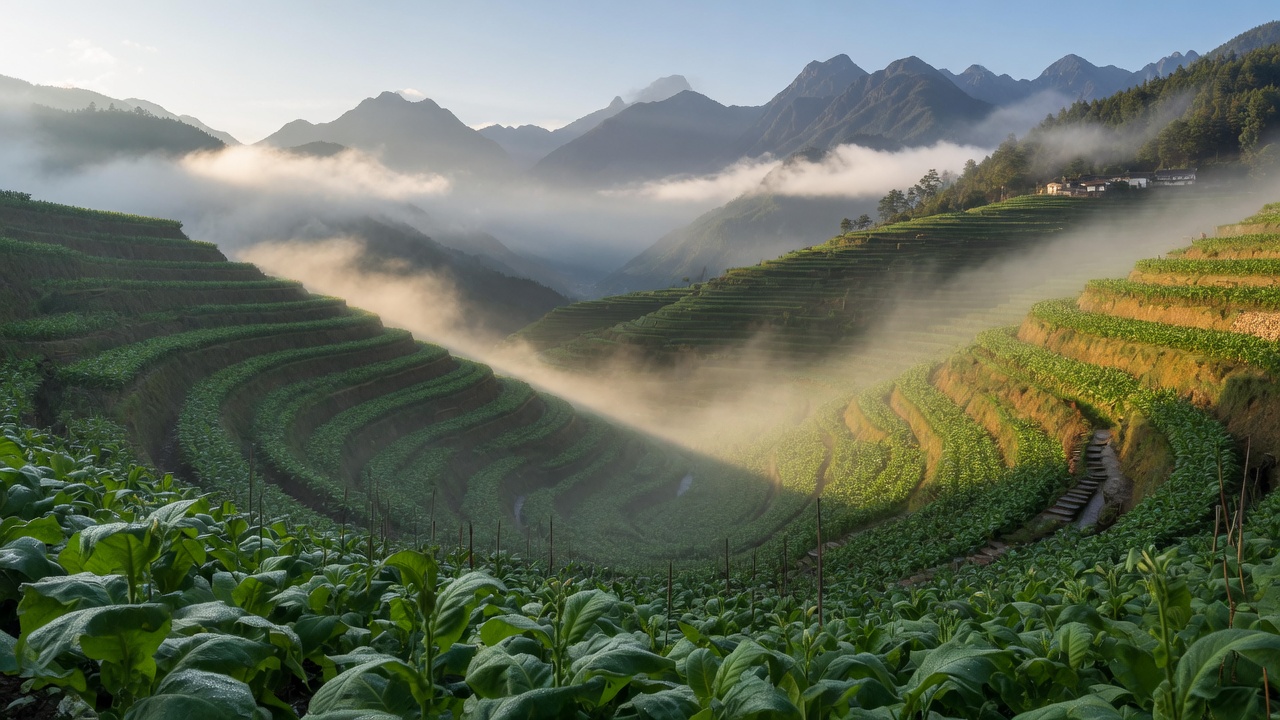
In the tobacco fields at an altitude of about 1700 meters in Honghe Prefecture, Yunnan, the air is thin with a distinctive coolness. Standing among the continuous terraced fields, watching the tobacco leaves growing in the mist, I often ponder one question: how exactly does this difference of a few hundred meters reshape the soul of these leaves at the microscopic level? For tobacco researchers, altitude is not just a geographic coordinate — it is a set of complex environmental variables: air pressure, temperature, light intensity, day-night temperature difference. These variables intertwine, and by altering the plant's physiological metabolism, they ultimately determine whether a cigarette burns smooth as silk or harsh and irritating.
Chemical Composition Reshaping Under the Altitude Gradient
In long-term field observations and physicochemical analyses, there is an extremely clear negative and positive correlation between altitude and key tobacco chemical components. This is not a simple linear relationship, but a precise game about "nitrogen metabolism" and "carbon accumulation."
Taking a gradient experiment we once conducted in Luoping County, Yunnan, as an example. We set sampling points between altitudes of 1400 meters and 2000 meters. As altitude increased, the data showed a striking trend. At sampling points between 1400-1600 meters, the nicotine content of tobacco leaves averaged around 2.25%, and total sugar content was approximately 29.88%. However, when we moved to high ground near 2000 meters, nicotine content significantly decreased to 1.95%, while total sugar content climbed to 31.97%.
The biological mechanism behind this phenomenon is profound. First is the nitrogen "deficiency" effect. At high altitudes, due to reduced air pressure, the availability of nitrogen in the soil is often limited; more importantly, lower temperatures inhibit the tobacco root system's absorption efficiency of nitrogen, while also slowing the conversion rate of organic nitrogen to nicotine synthase in the plant. Nicotine, as a secondary metabolite, is highly dependent on nitrogen supply. When "raw materials" are limited, the synthesis pathway naturally shifts in other directions.
At the same time, carbohydrate accumulation is "celebrating." High altitude areas experience sharp day-night temperature differences. During the day, abundant ultraviolet radiation promotes efficient photosynthesis, accumulating large amounts of sugars; at night, low temperatures significantly inhibit the plant's respiratory consumption. This state of "high accumulation, low consumption" causes reducing sugars and total sugars to pile up in leaf tissue in large quantities. Data indicates that for every 200-meter increase in altitude, the percentage of reducing sugars tends to increase by about 1%. This shifting composition constitutes the unique chemical profile of high-altitude tobacco leaves.
From Molecules to Flame: The Chain Reaction of Combustion Characteristics
If changes in chemical composition represent "internal" changes, then combustion characteristics are the manifestation of "technique." When tobacco leaves burn, it is essentially a complex oxidation-reduction reaction, and the chemical composition serves as the "fuel" and "catalyst" of this reaction.
We observed that due to their higher sugar content, high-altitude tobacco leaves generally exhibit a better comprehensive combustion characteristic index (Z value). In thermal analysis experiments, high-sugar tobacco leaves often show lower peak combustion temperatures (Tmax). This may seem counterintuitive — more sugar, but the fire is more "gentle"? In fact, appropriate amounts of sugar act as a "softening agent" during the pyrolysis process. They promote the degradation of biological macromolecules, making the combustion process more stable, avoiding instantaneous violent deflagration, thereby improving combustion continuity and stability.
However, this "gentleness" is a double-edged sword. Another result of high sugar content is the change in smoke composition. During the pyrolysis stage, large amounts of polysaccharides and cellulose are converted into carbonyl compounds, such as formaldehyde, acetaldehyde, and various furans. This causes high-altitude tobacco leaf smoke to exhibit more noticeable acidity (lower pH value), making the taste fuller and rounder, but possibly also increasing a certain irritation due to higher carbonyl compound concentrations.
In stark contrast, the decrease in nicotine content directly affects the alkalinity and physiological intensity of the smoke. Nicotine and related nitrogenous substances contribute to the alkalinity of smoke during combustion and provide a unique physiological stimulation. Due to lower nicotine levels, high-altitude tobacco leaves often taste "lighter," lacking the strong impact of low-altitude leaves. For varieties pursuing extreme "impact," high-altitude growth may actually be a challenge.
Additionally, we cannot ignore the synergistic effect of minerals — especially potassium (K) and chlorine (Cl). Changes in altitude often alter the proportion of mineral elements through soil leaching. In actual production, we found that the potassium/chlorine ratio (K/Cl) is key to determining combustion rate. If high-altitude areas can maintain a high K/Cl ratio through precision fertilization, they can greatly compensate for combustion retardation caused by excessive sugar, achieving a balance of "high sugar, high stability, high quality."
Practical Considerations and Regulation Suggestions
In long-term field management, I found that many growers fall into a misconception: believing that higher altitude means better quality. This view is too one-sided.
In high-altitude production areas, the core contradiction we face is between "maturity problems caused by insufficient heat" and "quality advantages brought by component accumulation." Although the sugar-to-nicotine ratio of high-altitude tobacco leaves (usually between 6-10) is very ideal, if the altitude is too high (e.g., exceeding 2100 meters), due to insufficient effective accumulated temperature, the maturity of tobacco leaves will significantly decrease, leading to insufficient organic matter accumulation, excessive cellulose content, and incomplete combustion.
Based on this, I suggest adopting the following strategies in high-altitude tobacco areas:
Conclusion
The impact of altitude on tobacco leaves is a precise orchestration in the microscopic world. From changes in air pressure to fluctuations in enzyme activity, from sugar accumulation to fluctuations in flame temperature, every link is interconnected. Understanding this logic allows us to shift from simply "relying on nature" to truly "precision cultivation." In future tobacco scientific research, how to simulate or optimize the metabolic advantages brought by altitude through artificial means will be the direction of our continuous exploration.