How Processing Changes Tobacco Composition — The Impact of Curing, Fermentation, and Additives
In the fall of 2019, near Yuxi, Yunnan, I visited a cooperative curing station. Middle-stalk leaves harvested the same morning were split into two batches: one went into a bulk curing barn following the standard flue-cured curve, the other hung in a ventilated barn to lose moisture slowly in the burley style. Three weeks later, both piles looked "dry," but chemically they were already two different materials. The flue-cured batch had a distinct sweet and roasted aroma when broken open—sugars locked inside the leaf. The air-cured batch had little sweetness, heavier nitrogenous notes, and a browner leaf surface. Same field, same stalk position—processing changed the endpoint.
Many people understand processing as "turning green leaves into dry leaves you can smoke." The more I compare, the more I find this understates it. Processing reshapes the final product: whether starch becomes sugar or is burned off by respiration, whether protein remains harsh or breaks down into amino acids then participates in Maillard reactions, whether nicotine is retained, partially degraded, or perceived as more "free-base" in the smoke, how far polyphenols oxidize, whether ammonia is suppressed—these are not style labels on the package, but the composition table rewritten by time, temperature, humidity, and human intervention.
Below I explain this through three lines: curing, fermentation, and additives. I write about mechanisms and consequences, not process worship.
I. Curing and Processing: First Decide Whether "Sugar or Nitrogen" Takes the Lead
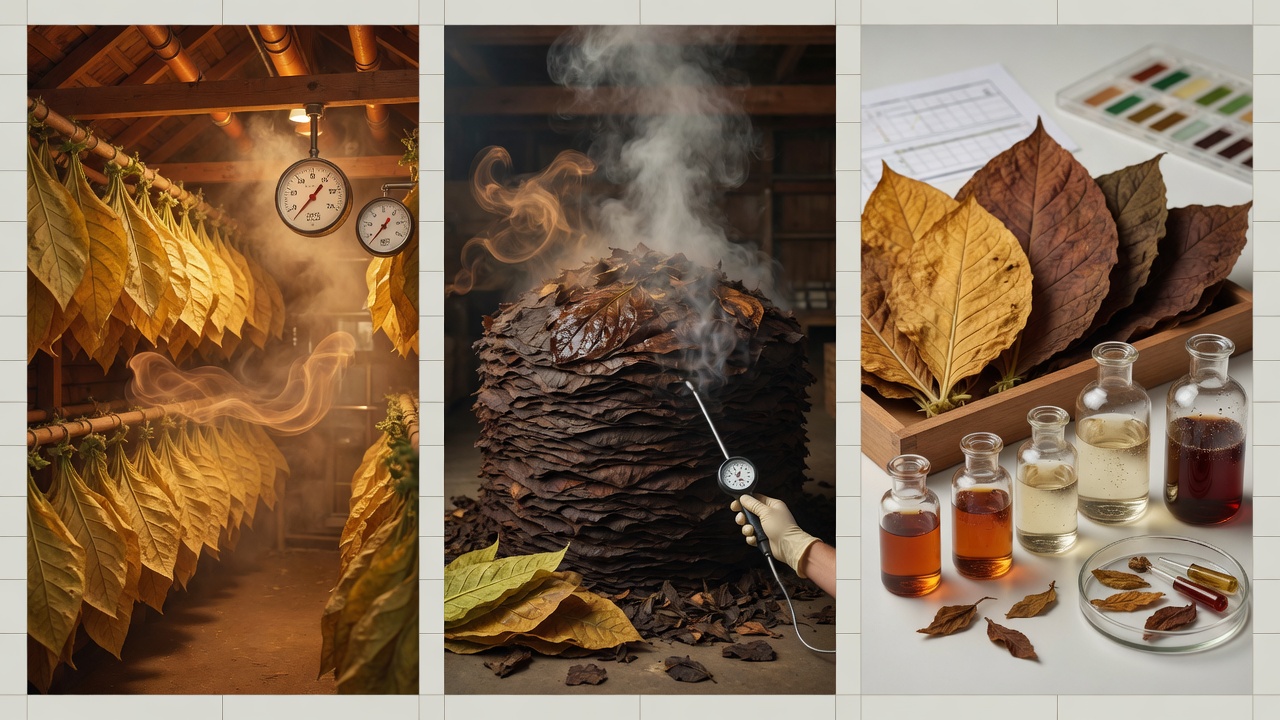
In fresh field leaves, starch, protein, chlorophyll, nicotine, and moisture coexist. After harvest, the first real game-changer is curing. Different paths handle the enzyme activity window completely differently, so endpoint compositions can differ by orders of magnitude.
1. Flue-cured: High Temperature Quickly Shuts Down Sugar Metabolism, Turning Starch into "Combustible Sweetness"
A typical flue-cured bulk barn goes through yellowing, color-fixing, and stem-drying stages. During yellowing, temperatures are around 35–42°C with high humidity, and leaf hydrolytic enzymes are active: starch hydrolyzes into soluble sugars, large proteins begin partial degradation, chlorophyll breaks down, and leaves turn from green to yellow. Aroma precursors are laid down extensively during this stage—complex macromolecules break into smaller intermediates.
The key is color-fixing. As temperature rises and humidity drops, the enzyme system is rapidly inactivated. Sugar metabolism doesn't have time to burn off all the newly formed reducing sugars, so they are "locked" in the leaf. Common ranges in industry and published data: flue-cured (Virginia type) total sugar can reach approximately 8%–30% in this broad range, depending on variety, maturity, and whether the curing curve drifted. Sun-cured (Oriental/turkish) sugar content also typically falls around 10%–20%, but the style is more resinous, spicy, and sun-character-driven.
In 2021 I helped review a failed cure: color-fixing was too slow, middle leaves lingered too long around 38°C, resulting in clearly low total sugar; in sensory evaluation the sweetness collapsed and off-notes emerged. Operationally, the temperature-humidity curve "rubbed" in the window where enzymes were still active—processing is not mysticism, it's an enzyme reaction timetable.
Flue-cured smoke tends to be acidic (in public discussion, mainstream cigarette smoke pH is commonly around 5.6–6.3), related to higher sugar content and organic acid formation during burning. If you find a cigarette "smooth, sweet, not harsh on the throat," chances are it's not the filter's magic but the curing that preserved the sugar system.
2. Air-cured (Burley-type): Slow Drying Lets Respiration Nearly Deplete the Sugars
Burley and other air-cured tobaccos take a different path: slow moisture loss in natural conditions or ventilated barns, relatively low temperatures, allowing enzyme activity and respiration to continue for a long time. Starch also hydrolyzes into sugars, but these sugars are continuously consumed during the long air-curing period, and the endpoint is often reducing sugars nearly exhausted. So the composition flips: low sugar, relatively prominent nitrogen compounds, more alkaline smoke, more "impact," more bitter and pungent, with greater ammonia and off-note management pressure.
EU promotional materials also repeatedly emphasize this point: Virginia/flue-cured tends to be high in sugar and low in nitrogen, while burley, through slow drying that consumes sugar, has relatively higher nitrogen. Therefore, in blended cigarette formulas, flue-cured contributes sweetness and filler burn, while burley contributes body and structure—this is not a perfumer randomly adding flavors, but two curing products that are chemically complementary.
I first put pure burley and pure flue-cured test smokes side by side in 2017 in a small warehouse in Guangzhou. The burley had almost no "candy feel," with more irritation in the rear nasal passages; the flue-cured tasted like someone had added a caramel base. Later, checking the composition confirmed: the difference I perceived was essentially the sugar-nitrogen ratio rewritten by curing.
3. Sun-cured: The Third Sugar-Nitrogen Balance Between Sunlight and Humidity
Sun-cured tobaccos like Oriental fall between the two—sugar doesn't get depleted like burley, nor is it locked in as high as flue-cured. The surface drying from sunlight, diurnal temperature variation, and leaf surface chemical reactions push resinous and volatile oil styles to the forefront. Processing changes not only "sweetness" but also what substrates microbes can feed on during subsequent fermentation.
Personal view: The curing stage is the main switch for composition divergence. Later fermentation and additives can patch and beautify, but it's difficult to turn "sugar-depleted air-cured leaf" into "high-sugar flue-cured leaf" without exogenous sugars and flavorings. Whenever I see marketing claiming "pure leaf essence, zero processing" while the taste resembles sweetened blends, I default to suspecting an incomplete processing narrative.
II. Fermentation and Aging: Turning "Smokeable" into "Good" While Continuing to Modify Molecules
Flue-cured
- High sugar (8%–30%)
- Acidic smoke (pH 5.6–6.3)
- Sweet, roasted sweet
- Enzymes rapidly inactivated, sugar locked
Air-cured
- Low sugar (near depletion)
- Alkaline smoke
- High impact, heavy off-notes
- Respiration depletes sugar, N prominent
Leaves after curing often still carry green off-notes, ammonia irritation, and uncoordinated proteins and polyphenols. Fermentation and longer-term aging are the second round of compositional reshaping. Cigar leaves especially depend on this step; flue-cured strip tobacco also undergoes aging and enzyme treatment paths.
1. What Happens in the Pile: Enzymes, Microbes, and Heat—Three Forces Breaking Down Molecules Together
Traditional cigar pile fermentation (pilón) stacks leaves into piles; residual moisture, respiration, and microbial activity generate heat, and the core temperature can rise to approximately 45–60°C (depending on pile height, moisture content, and turning frequency). Workers use touch and thermometers to decide when to break down the pile for cooling and restack to prevent burning. In 2018 I visited a turning operation near Santiago, Dominican Republic: by 10 AM the core was already hot to the touch, and the master said waiting half a day more would mean the center leaves would be "overcooked" while the edge leaves were fine. After that, I stopped understanding fermentation as "let it sit and ripen."
Common chemical directions include:
- **Carbohydrates and nitrogen compounds simultaneously decrease or redistribute**: polysaccharides and proteins are hydrolyzed; free amino acids rise then participate in subsequent reactions.
- **Polyphenol oxidation**: bitterness and raw green notes decrease, color deepens.
- **Partial nicotine degradation**: literature and reviews indicate that nicotine can undergo considerable loss during drying and fermentation (discussions commonly cite approximately **30%–50%** depending on process and starting content, not a fixed formula for all regions). Degradation products and the subjective sensation of "strength" are not always linear.
- **Ammonia and irritation decrease**: nitrogenous off-notes are transformed or volatilized, the smoking experience shifts from "harsh" to "rounded."
- **Aroma compounds rise then fall**: carotenoid degradation products (such as β-damascenone, megastigmatrienones), cembranoid degradation products, and Maillard-related small molecules (furfural, methylfurfural, acetylpyrrole, etc.) accumulate during mid-fermentation. Studies observe total aroma in cigar wrapper pile fermentation peaking around **14–21 days**, with artificial fermentation paths also reporting inflection points around **25 days**; beyond that, longer is not necessarily better—over-fermentation continues to consume aroma compounds and increases the risk of mold and flatness.
Cigar smoke, being relatively high in nitrogen compounds and low in sugar, burns more alkaline (reported cigar smoke pH can fall in the approximately 6.2–8.6 range), a completely different chemical script from the acidic sweetness of flue-cured cigarettes. Fermentation cannot turn cigars into "low-nicotine health food"; what it does is suppress harsh nitrogenous off-notes and bring out cocoa, roasted, and nutty Strecker aldehydes.
2. Enzyme Preparations and Accelerated Fermentation: Artificially Speeding Up "What Should Drop Drops, What Should Rise Rises"
When protein levels are too high, burning can produce odors similar to burnt hair and a pungent bitterness. Industrial and patent paths commonly include spraying amylase, protease, cellulase, pectinase, etc., to drive starch→sugar, protein→amino acids, then push Maillard reactions, increasing furfural, benzaldehyde, 5-hydroxymethylfurfural, and other aroma compounds. Some paths report that after cellulase treatment, cellulose and nicotine decrease while reducing sugars and aroma compounds increase, and the fermentation cycle can be shortened.
I've also seen overcorrection: excessive enzyme load and humidity cause the leaf surface to become sticky, local sourness, and the sensory evaluation becomes cloyingly sweet and stuffy. In a 2020 small-scale trial, we blind-tested the enzyme-treated sample against the control: two out of three people found it "smoother," while one felt it "lost the leaf's own green-spicy layering." Processing changes composition with no free lunch—you reduce harshness, but you may also reduce distinctiveness.
3. Aging Warehouse: Slow Variables That Change Volatile Acids, Free Base, and Balance
After strip blending, tobacco is stored in temperature- and humidity-controlled warehouses for months to years; oxidation and slow enzyme reactions continue. Published industry research mentions that aging can reduce total volatile bases, some sugars, and nicotine, while the proportion of volatile acids increases and the proportion of nicotine in free-base form may change, thereby altering the "impact sensation at the same nicotine content." Higher moisture content and stacking temperature tend to result in greater nicotine loss.
Personal view: Fermentation is the soul of cigars and some deeply processed tobacco leaves, but "the longer the fermentation, the better" is a false rule. Aroma has a peak window; beyond the peak lies flatness and risk. For consumers, the more useful question is not "how many years fermented" but "was the peak captured, was there burning or mold."
III. Additives: The Third Knife, Directly Modifying "What You Inhale"
If curing determines the skeleton and fermentation determines the roundness, additives are the last rewrite of smoke chemistry and sensory perception before combustion. Additives discussed here include: sugars and syrups, humectants (glycerol, propylene glycol, etc.), flavors and fragrances, acidity regulators, combustion aids, as well as exogenous materials sprayed during fermentation (coffee, cocoa, rice wine, spice extracts, etc.) and industrial Maillard reaction products.
1. Sugar Additives: Compensating for Air-cured "Emptiness," Creating Blended "Smoothness"
If low-sugar leaves like burley are used in large amounts directly, the smoke tends to be alkaline and harsh. Industry commonly adds sugar or sugar-containing liquids; during combustion, acids are generated, partially neutralizing alkalinity and enhancing sweetness and "smoothness." FDA-related reviews also point out: air-curing's slow drying causes sugar to be metabolized away, while flue-curing/sun-curing retain higher sugar due to rapid high-temperature inactivation of sugar metabolism—subsequent sugar addition is essentially a secondary edit of the curing result at the formulation level.
When I compare same-tar-level "pure flue-cured" test products with commercial "flue-cured + burley + sugar" products, the latter is often smoother and easier to inhale, but the leaf's intrinsic aroma is more blurred. Compositionally this is not a scam; it's design: additives push the endpoint from "raw material authenticity" to "brand consistency."
2. Flavors, Exogenous Materials, and Maillard Pre-reaction Products: Moving Style from Inside the Leaf to the Formula
In cigar fermentation research, spraying cumin, Rhodiola, coffee, cocoa, and other exogenous materials can change total sugar, alcohols, olefins, ketones, and some marker aroma compounds (with reports of neophytadiene showing multiple-fold changes), and introduce new volatile profiles; rice wine treatment can elevate Maillard reaction products; the carbohydrates and alcohols brought by flavor additives can also alter microbial communities, accelerating esterification and Maillard reactions, bringing the aroma peak forward.
On the cigarette side, flavor and fragrance lists and Maillard reaction products (e.g., certain amino acid-sugar reaction products) are more commonly used to supplement roasted and sweet notes and soften harshness. Reconstituted tobacco sheet itself is a reconstituted product of "tobacco dust + added fibers, adhesives, and ingredients," and its composition table has never been "a single original leaf" from day one.
3. Humectants and Combustion-related Aids: Changing Physical State, Indirectly Modifying Exposure
Humectants change moisture content and the combustion cone temperature curve, indirectly affecting tar, nicotine transfer, and aldehyde formation. Combustion aids change the smoldering rate. If you find a cigarette "always equally moist and smooth," chances are there's a humectant system supporting it—this too is processing's control over the final product, not a personality the leaves developed on their own in the warehouse.
Personal view: Additives are most easily moralized ("adding is cheating" or "adding is high-tech"). A more balanced view is: additives are industry's compensator and style adjuster for the results of curing and fermentation. They can reduce batch variation and improve palatability, but can also mask inferior raw materials. Reading composition and processing is to judge "whether what you like is the leaf, or the formula."
IV. How the Three Knives Stack into the "Final Product"
Stringing these three lines together gives a clearer causal map:
| Stage | Primary Target Modified | Typical Product Consequences |
| Flue-curing | Locks sugar, reduces green, lays aroma precursors | Smoke sweeter, more acidic, roasted sweet aroma |
|---|---|---|
| Air-curing | Depletes sugar, relatively elevates nitrogen | Smoke more alkaline, higher impact and off-note management pressure |
| Fermentation/Aging | Protein/nicotine/polyphenols/ammonia, Maillard & carotenoid degradation | Reduced harshness, aroma peak, style rounded or over-fermented flat |
| Additives | Exogenous sugar, flavor, enzymes, humectants, pre-reaction products | Batch stability, reproducible style, leaf identity diluted or masked |
So, the final product is not the abstract noun "tobacco" but the intersection of "certain variety × certain curing × certain fermentation window × certain additive system." Two cigarettes with similar labeled nicotine content can have vastly different impact sensations because their free-base ratios, sugar-nitrogen ratios, ammonia residues, and additive sweetness profiles are completely different.
For those working on nasal snuff, oral tobacco, heated tobacco, and other harm-reduction or alternative routes, this map is equally useful: the "tobacco extracts," "nicotine salts," and "tobacco flavor" you face have also undergone curing and industrial processing upstream. Changing the inhalation route does not mean returning to "unprocessed natural leaves." Processing changes the exposure form and partial harmful substance profiles, but does not automatically grant a safety exemption card.
V. Traps I've Stepped Into, and My Current Judgment
Trap 1: Using "color depth" to judge whether fermentation is adequate.
Dark doesn't mean good. Over-oxidation and localized burning can also produce deep color. More reliable indicators: whether green off-notes have receded, whether the tactile feel is uniformly oily, whether the smoke transitions from harsh to layered bitter-sweet and roasted aroma—not just looking at photos.
Trap 2: Equating "high sugar" with "low harm."
Flue-cured high sugar is smooth, and the aldehyde and acid pathways during combustion are also different. Smoothness is a sensory evaluation, not a toxicological conclusion. After quitting cigarettes myself and switching to observing alternatives, I'm more alert to the illusion that "smooth = safe."
Trap 3: Small-scale home "fermentation" copying tropical pilón.
Without humidity control, mold can develop within 48 hours. In 2022, a friend in southern China's humid season sealed tobacco leaves in plastic bags for "fermentation"; when opened on day three, there was obvious mold. Processing requires controlled water activity and temperature, not stuffy moisture.
My clear views:
- **Processing is the author of composition; the field is just the first draft.** The same draft can become flue-cured sweet, burley impactful, or cigar fermented.
- **Curing decides the sugar-nitrogen foundation, fermentation decides the harshness and aroma peak, additives decide the industrially reproducible finish.** The weights differ across products, but no honest account of flavor can be given by "talking only about growing, not processing."
- **Complex processes are not nobler, nor are they healthier.** Complexity means more controllable variables, meaning style can be designed and standardized, and also means the "premium feel" you perceive may come from additives and fermentation timing, not moral purity.
- **For consumers, understanding processing is for clearer choices and clearer quitting:** if you like a certain smoothness, know that's sugar-nitrogen and additive engineering; if you want to reduce dependence, don't be soothed by "natural fermented leaf" rhetoric.
Conclusion
Back to those two piles of leaves from 2019: they proved that processing is not post-harvest finishing, but compositional reshaping itself. Curing determines whether sugar is locked in or consumed by respiration; fermentation pushes proteins, nicotine, polyphenols, and ammonia through a series of enzyme and microbial reactions, building or destroying aroma within a window of two to three weeks; additives write the final revision of combustion chemistry and brand memory before the product leaves the factory.
Next time someone only tells you the origin legend, you can ask one more question: how was this leaf cured, on what day was the pile turned, were any sugars or flavors added externally. The final product is written in those three answers, not in the advertising copy.