Technical Parameter Settings for Tobacco Drip Irrigation and Sprinkler Irrigation and Their Impact on Leaf Thickness and Combustion
In late July 2022, the fields in a certain tobacco-growing area in southern Yunnan were at their most anxious moment. Three consecutive days of extreme heat caused the soil surface to crack rapidly—a thirst that was felt not only by the plants but also by the growers themselves. As a technician who has been working in tobacco-growing areas for fifteen years, I know deeply that every irrigation at this time is essentially a gamble with the "fate" of the leaves. Many beginners think that if the plants are thirsty, just water them—there's no difference. But I tell you, in tobacco cultivation, your irrigation method, timing, and precision directly determine whether you end up harvesting golden leaves or only "waste" that can only be sent to the processing plant for shredding.
The Art of Precision: Parameter Game in Drip Irrigation
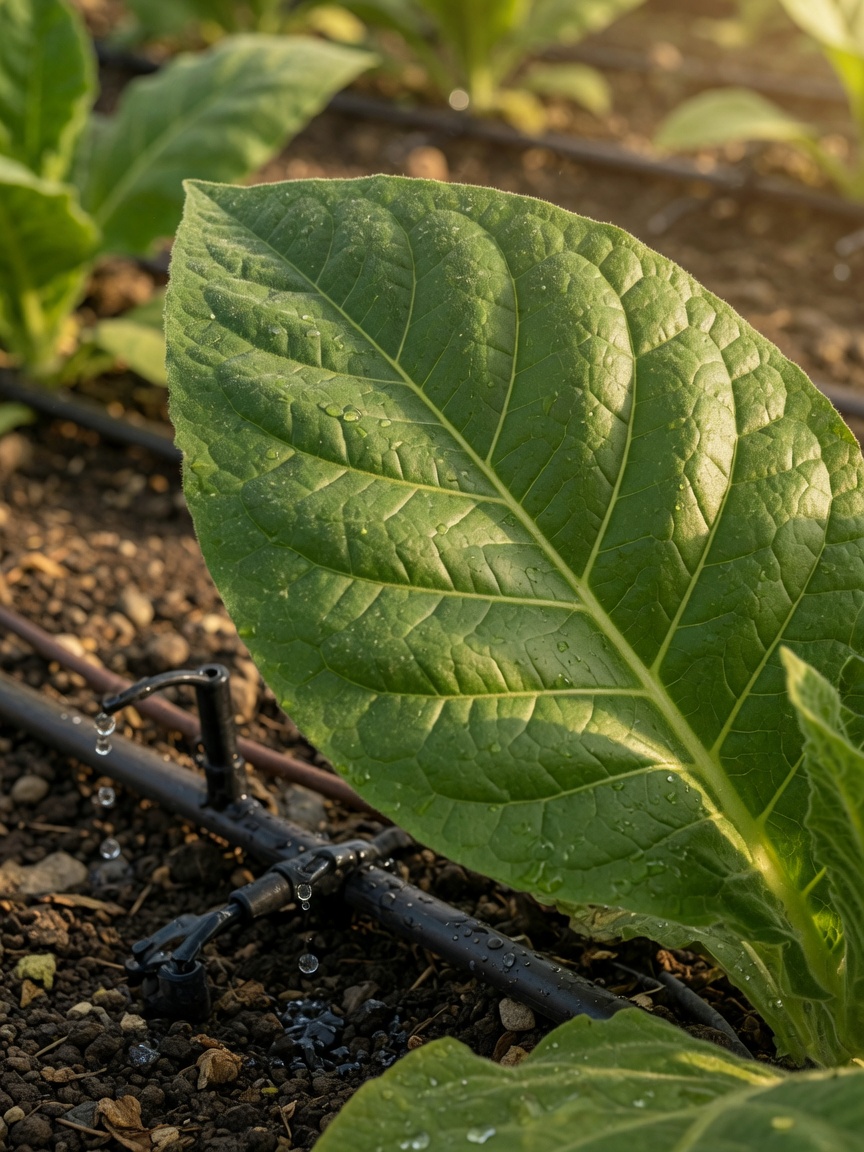
In modern tobacco cultivation, drip irrigation is nothing new, but mastering drip irrigation in different soil types is extremely challenging.
I recall when I was handling a drip irrigation system in a sandy soil area, the core challenge was not "how much water to give" but "how to give it." For this type of soil, water infiltrates very quickly. If the dripper flow rate is too high, water will rapidly drain below the root zone, causing the root area to remain in an extreme "dry-wet alternation" state.
For this situation, the technical parameters I recommended were: dripper flow rate controlled between 1.6–2.0 L/h, with a smaller spacing of 30 cm. Why 30 cm instead of the conventional 50 cm? Because in sandy soil, we need high-density drippers to build a more continuous and stable wetting zone, preventing roots from over-expanding downward in search of water, which would slow above-ground growth. At the same time, the working pressure must be strictly maintained at a low pressure of 0.1–0.2 MPa. If the pressure increases, the dripper flow rate becomes uncontrollable, and the uniformity coefficient (CU) of water distribution drops sharply. The end result is: some leaves become "lazy green" due to excessive moisture, while others are underdeveloped due to water deficiency.
The irrigation frequency must also be dynamically adjusted according to the tobacco growth stage. In the root extension stage, we aim for "stability," irrigating every 6–8 days to maintain soil moisture at 60%–70% of field capacity. At this stage, do not overwater—once water is excessive, the root system becomes weak, and the later lodging resistance is extremely poor.
In the vigorous growth stage—the "fleshing out" stage—water demand increases exponentially. At this point, irrigation frequency should be increased to once every 2–4 days, with each irrigation volume calculated based on daily evapotranspiration (ET₀) combined with an irrigation coefficient (r=0.8–1.0) to ensure soil moisture remains at 80%–90%. I once observed a case where missing just one irrigation during the vigorous growth stage caused the leaf thickness in that area to drop by about 0.1mm in only three days. This subtle change later directly resulted in insufficient leaf filling, known colloquially as "no meat."
In the maturity stage, we need to "harvest," irrigating every 4–6 days to control moisture at around 60%–70%, which helps the leaves gradually mature and promotes yellowing.
Cooling and Regulation: The Applicable Boundaries of Sprinkler Irrigation
Of course, drip irrigation is not a panacea. In some terrains with large undulations or when microclimate regulation is needed, sprinkler irrigation still has its irreplaceable role.
The logic of sprinkler irrigation lies in "simulating rainfall" and "environmental regulation." During extreme high temperatures, sprinkler irrigation can quickly lower leaf surface temperature and alleviate heat stress in plants. I typically recommend using fine mist nozzles with a diameter of 1–2 mm. This droplet diameter ensures uniform coverage without causing mechanical damage to the leaves from large droplets, and without evaporating instantly due to being too fine.
The parameter settings for sprinkler irrigation are relatively complex. Taking common rotating sprinklers as an example, the flow rate is approximately 400 L/h, with a layout spacing of about 10 m × 12 m. The key here is the overlap of range radii—the uniformity coefficient must be greater than 85%. If the spacing is too large, obvious "dry spots" appear. The leaves in these dry spots become abnormally stiff and uneven in thickness, greatly affecting subsequent grade evaluation.
But I must warn everyone: sprinkler irrigation is a double-edged sword. If you frequently use sprinkler irrigation during the maturity stage, you are essentially ruining your own prospects. Excessive air humidity and frequent leaf wetness directly induce diseases like gray mold. Worse, it disrupts the accumulation of nutrients in the leaves, causing the leaves to become "puffy"—looking green and thick on the outside but loose in texture and extremely low in sugar content.
Core Logic: How Water Reshapes the "Skeleton" and "Soul" of Leaves
Why are we so obsessed with these parameters? Because water directly controls two core properties of leaves: physical thickness (skeleton) and chemical quality (soul).
First is physical thickness. Leaf thickness depends not only on cell division rate but also on cell turgor maintenance. During the vigorous growth period, sufficient and uniform water supply ensures that leaf cells maintain high tension during expansion, forming compact, thick cell wall structures. I once compared two sets of experimental data: one area using precise drip irrigation with stable water content at 85% had an average leaf thickness of 0.28mm; another area using intermittent sprinkler irrigation with drastic moisture fluctuations had a leaf thickness of only 0.22mm, with very loose leaf texture.
Second is chemical quality—the key to combustion performance. The combustibility of tobacco is determined by the ratio of sugar, alkali, potassium, and chlorine within the leaf. Improper water management directly leads to imbalances in these elements.
Here is a very crucial piece of knowledge: water indirectly controls combustion uniformity by affecting the absorption efficiency of potassium (K) and chlorine (Cl). In a drip irrigation environment, due to integrated water and fertilizer management, nutrient supply is very stable, and potassium fertilizer can be efficiently absorbed by the root system, helping to form more stable cell structures, thereby improving the smoldering time of combustion. Conversely, if irrigation is improper (such as frequent leaf wetting caused by sprinkler irrigation), leaves tend to absorb excessive chlorine ions, which not only increases ash content but also makes the smoke harsh and the combustion process extremely unstable, alternating between fast and slow.
Practical Case: A Painful Lesson About "Thickness" and "Combustion"
I want to share a real lesson.
It was 2021, when I was guiding a large-scale tobacco cooperative. Due to high temperatures and drought at that time, the cooperative's technician, in an attempt to quickly alleviate the crop's drought stress, decided to switch to high-flow sprinkler irrigation during the vigorous growth stage, trying to "save the crop" by increasing the water volume.
Within just two weeks, we saw the consequences.
At harvest, the tobacco leaves from that area looked very beautiful—dark green in color and visually thicker, even slightly thicker than the leaves from the surrounding drip-irrigated area. The cooperative manager was very pleased, thinking it was a great harvest. However, when the first batch of samples was sent to the laboratory for combustion performance testing, the results were shocking: the smoldering time was extremely short, the combustion speed was abnormally fast, and the burning process was accompanied by a large amount of sparks and excessive ash content.
In-depth analysis revealed that the excessive water supply during that period caused the leaves to look "thick" physically, but the internal cellular structure was "hollow." The water had over-expanded the cells, but due to severe nutrient leaching, the sugar-alkali ratio within the leaves was severely imbalanced. These "puffy" leaves had an extremely loose structure. Once ignited, due to the lack of sufficient solid matter support and stable chemical composition, the combustion process was like burning dry grass—instantaneous burnup, completely unable to meet the requirements of high-quality tobacco.
This lesson tells us: the thickness of tobacco is not "propped up" by water, but "grown" by the synergy of water and nutrients.
Summary and Advanced Recommendations
In practical operation, to achieve ideal leaf thickness and excellent combustion performance, I recommend following three principles:
First, measure first, reject empiricism. Do not rely solely on visual observation of soil dryness. You must equip soil moisture sensors, or at a minimum master the calculation method of ET₀ (reference crop evapotranspiration). Dynamically adjust the irrigation quota based on the physiological needs of different growth stages.
Second, prioritize integrated water and fertilizer management to control quality through drip irrigation. Drip irrigation is not just for water conservation—its true value lies in precisely regulating the chemical composition of leaves through accurate nutrient delivery combined with stable water supply, thereby controlling combustion performance at the source.
Third, beware of "puffy" risk and control moisture during the maturity stage. After entering the maturity stage, you must decisively adopt water control measures. Through moderate water stress, encourage the leaves to complete their final nutrient accumulation and promote leaf yellowing. At this point, "drought" is not a bad thing—it is meant to make the leaves "substantial."
Growing tobacco is an art of balance. Precise parameter settings are not just combinations of numbers but a deep respect for the rhythm of plant life. Only when we can precisely control the path of every drop of water flowing to the root system can we truly master the rhythm of that leaf's combustion.
Note: This article is based on years of practical experience in tobacco cultivation, aiming to provide technical reference for precision irrigation.
Drip Irrigation vs Sprinkler Irrigation
Drip Irrigation
Precise water control, integrated fertigation, suitable for all growth stages, uniform leaf thickness, stable combustion quality
Sprinkler Irrigation
Suitable for cooling and humidity regulation, use with caution in maturity stage, may cause puffy leaves, uneven combustion, increased ash content