The Technical Indicators for Judging Tobacco Field Maturity and the Impact of Harvest Timing on Combustion Quality
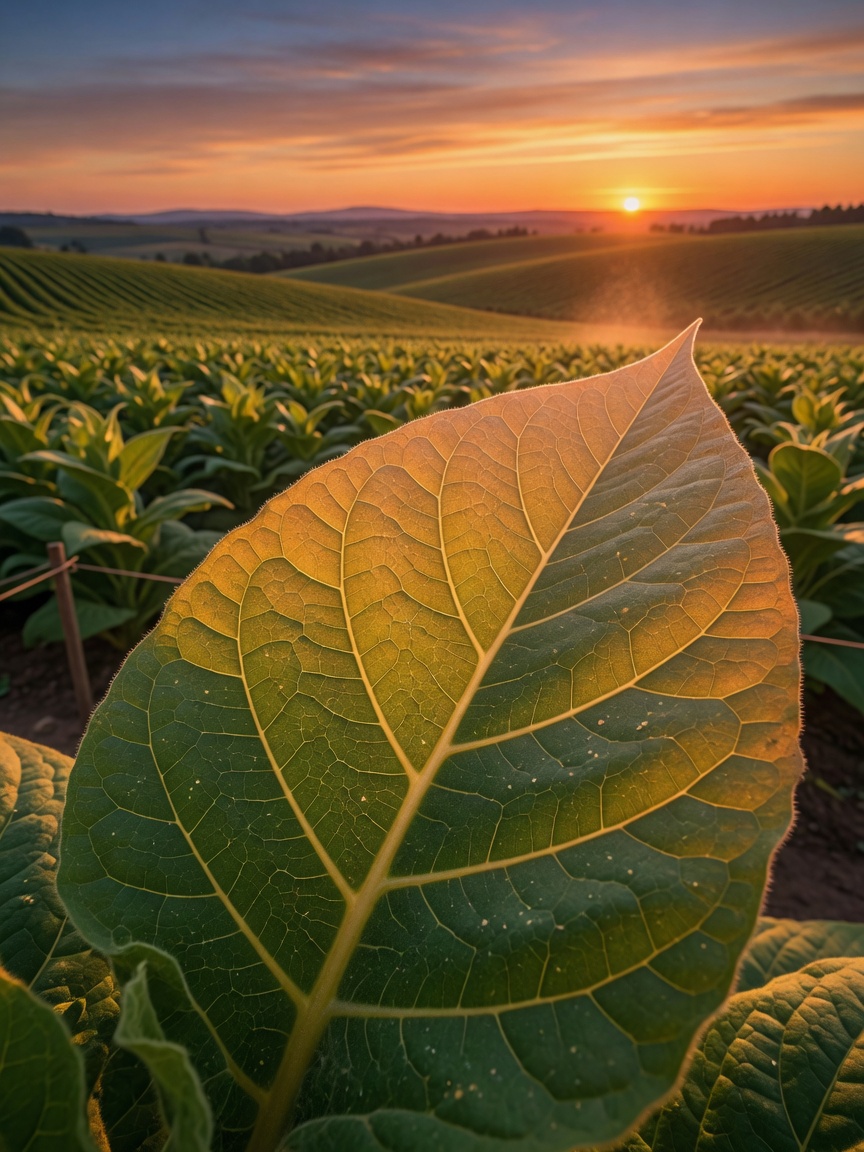
In the long cycle of tobacco cultivation, the decision made at the moment of harvest often determines the final fate of tens of thousands of mu of tobacco fields in that season.
I still clearly remember that deep autumn in 2018, in a core tobacco-growing area in central Yunnan, when the harvest originally planned for late October had to be brought forward due to two consecutive weeks of abnormally high temperatures. At that time, many growers hesitated unusually because they worried that over-ripe leaves would reduce yield. However, when our on-site sampling tests revealed that the reducing sugar content of those leaves had reached a critical peak while acidity was falling rapidly, I decisively ordered a full-scale harvest push. Looking back afterwards, if we had delayed by just one more week, once those leaves entered the over-ripe stage, the smoke density and aroma layering during combustion would have suffered a devastating blow.
Judging whether tobacco leaves have reached ideal maturity can never rely merely on "looking at the color". Experienced growers look at color, but a real expert must build a complete logical chain that goes from "visual perception" to "chemical quantification".
I. Observable morphological indicators: the intuition of the senses
When walking through the fields, our first sensory tools are vision and touch.
The first is the rule of color change. The process of tobacco leaf maturation is essentially a process of chlorophyll degradation. From deep green to yellow-green, and then to that "mature green" with a faint golden tint, this is the first threshold for judging maturity. If the color is still greenish, it means the chlorophyll content is too high. Such leaves, during the subsequent flue-curing process, because nitrogen content remains at a high level, will produce extremely strong irritation when burned — what we often call a "too hot" taste.
The second is leaf texture and vein features. In a mature leaf, the blade changes from thick and elastic to relatively thinner and somewhat brittle in texture. Pinching it gently with your fingers, you can feel a transition from "tough" to "crisp". At the same time, observing the color of the veins is crucial: the main vein and lateral veins turning from bright green to light yellow or brownish yellow is an important signal of physiological maturity. If the veins remain emerald green, it means the nutrients have not yet been fully transferred to the leaf flesh.
II. Measurable physical and chemical parameters: the bottom line of science
Sensory judgment is fast but subjective. In modern tobacco production, physical and chemical indicators must be used to calibrate the senses.
1. Sugar-Acid Ratio — the soul of combustion quality
This is the indicator I value most. As maturity increases, the organic acids in tobacco leaves (such as malic acid and citric acid) continuously degrade, while the content of reducing sugars (especially glucose and fructose) rises steadily. An ideal harvest window requires the sugar-acid ratio to stay within a specific dynamic range. If the sugar-acid ratio is too low (that is, acidity too high), the smoke will be sharp and throat-irritating; if the sugar-acid ratio is too high (that is, over-maturity), the smoke will become bland and lack vitality.
2. The dynamic balance between reducing sugar and total sugar
The content of reducing sugar is directly related to the "sweetness" and "fullness" of the smoke during combustion. In the middle and late stages of maturation, reducing sugar reaches a peak. What we need to pay attention to is the ratio of reducing sugar to total sugar, as fluctuations in this ratio directly affect the chemical stability of the smoke during combustion.
3. Control of nicotine content
Nicotine is the basis of smoke irritation and addictiveness. Although nicotine content fluctuates during maturation, we must ensure that at harvest time the nicotine content is within the standard range of the target variety. Harvesting too early may cause abnormal nicotine concentration and affect aroma release; harvesting too late may slow down nicotine biosynthesis, making the smoke feel "weak".
III. The causal chain between harvest timing and combustion quality
Why do we emphasize "precision harvesting" so strongly? Because a deviation in harvest timing will be infinitely amplified at the combustion stage.
Mistake one: harvesting too early (immature leaves)
The main characteristics of such leaves are "high nitrogen, high acidity, low sugar". During combustion, because of the high nitrogen content, large amounts of ammonia and carbon monoxide are produced, resulting in extremely strong smoke irritation, an overly fast burn rate, and unstable smoke concentration. From a sensory point of view, this smoke is "harsh", lacks aroma, and may even produce an unpleasant bitter-burnt taste.
Mistake two: harvesting too late (over-ripe leaves)
This is the mistake most commonly made by growers who chase yield. Over-ripe leaves are characterized by "low sugar, high ash content, and high moisture fluctuation". During combustion, because organic matter has degraded excessively, the aroma substances in the smoke (such as volatile components) are largely lost, making the smoke "flat" and "dull". More seriously, the ash content of over-ripe leaves rises significantly, which not only leaves excessive ash residue after burning but also makes the smoke heavy and dull, losing its proper layering and aftertaste.
IV. Practical pitfalls: how to make decisions in unpredictable fields
In actual operations, we often face the challenges of extreme weather. For example, continuous rainy weather directly affects the physiological metabolism of leaves, leading to moisture accumulation and interfering with the speed of sugar accumulation.
My advice to frontline technicians is only one line: do not blindly trust a single indicator; carry out "composite diagnosis".
When you observe in the field that the color has reached the standard but still have doubts about quality, immediately conduct a quick physical and chemical test. Use portable sugar-acid testing equipment, or make your decision with a combined assessment of leaf thickness and moisture content. Remember, yield is a result, but quality is the lifeline of tobacco. What we want is that "golden quality" which, when burned, produces full smoke, moderate sweetness, and a long-lasting aftertaste — not a pile of lifeless, dry leaves merely gathered to fill the warehouse.
In this industry, we are gambling against nature. Precisely mastering every parameter of maturity is essentially the search for that delicate balance point between the laws of natural growth and the needs of industrial production.
Comparing the two major harvest-timing mistakes
Harvesting too early (immature leaves)
High nitrogen, high acidity, low sugar; burning produces large amounts of ammonia and carbon monoxide, with extremely strong smoke irritation and an overly fast burn rate.
Harvesting too late (over-ripe leaves)
Low sugar, high ash content, and high moisture fluctuation; aroma substances are lost, ash rises, and the smoke becomes heavy, dull, and lacking in layering.