Tobacco Leaf Grading Standards and Selection Logic
\n\n
From the time tobacco leaves are harvested in the field to when they enter cigarette blending or cigar workshops, there is a critical step that largely determines "whether it can be used, where to use it, and how much it's worth": **grading and selection**. An outsider looking at tobacco leaves mostly sees "yellow, brown, broken, or whole"; an insider scans **color, thickness (body), oil content, and integrity** within seconds, then layers on position, maturity, blemishes, and batch consistency — finally arriving at a tradeable, blendable grade judgment.
\n\n
This article uses a "dimension + how to look in the field + how factories select" structure to explain what tobacco grading is about. First, five boundary conditions:
\n\n
1. **Grade describes raw material specifications and economic value, not safety.** High-grade leaves, ample oil, uniform color — none of these mean "healthier." The core health risks of combustible or heated tobacco products do not disappear because grading is more refined.
\n2. **Appearance grade ≠ the whole story of the final smoke.** Curing method, fermentation/aging, cutting/rolling, and smoking conditions continue to reshape the sensory experience; grading locks in **a rough range of usable raw material**, not the sole determinant of final flavor.
\n3. **Standards are a common language; field judgment still relies on training.** National standards, industry standards, enterprise controls, and the "master's eye" of cigar workshops can coexist; clauses are written on paper, but decisions depend on lighting, hand feel, and inspection discipline.
\n4. **Trends are not laws.** The same color means different things in flue-cured vs. air-cured tobacco; "thick" has different weight in filler vs. wrapper. This article provides common logic, not a one-size-fits-all formula.
\n5. **Factories often need "usable and uniform batches," not "every single leaf perfect."** Understanding this is key to seeing why some leaves with ordinary appearance are purchased in large quantities while some "good-looking" leaves cannot enter a certain production line.
\n\n
\n
\n
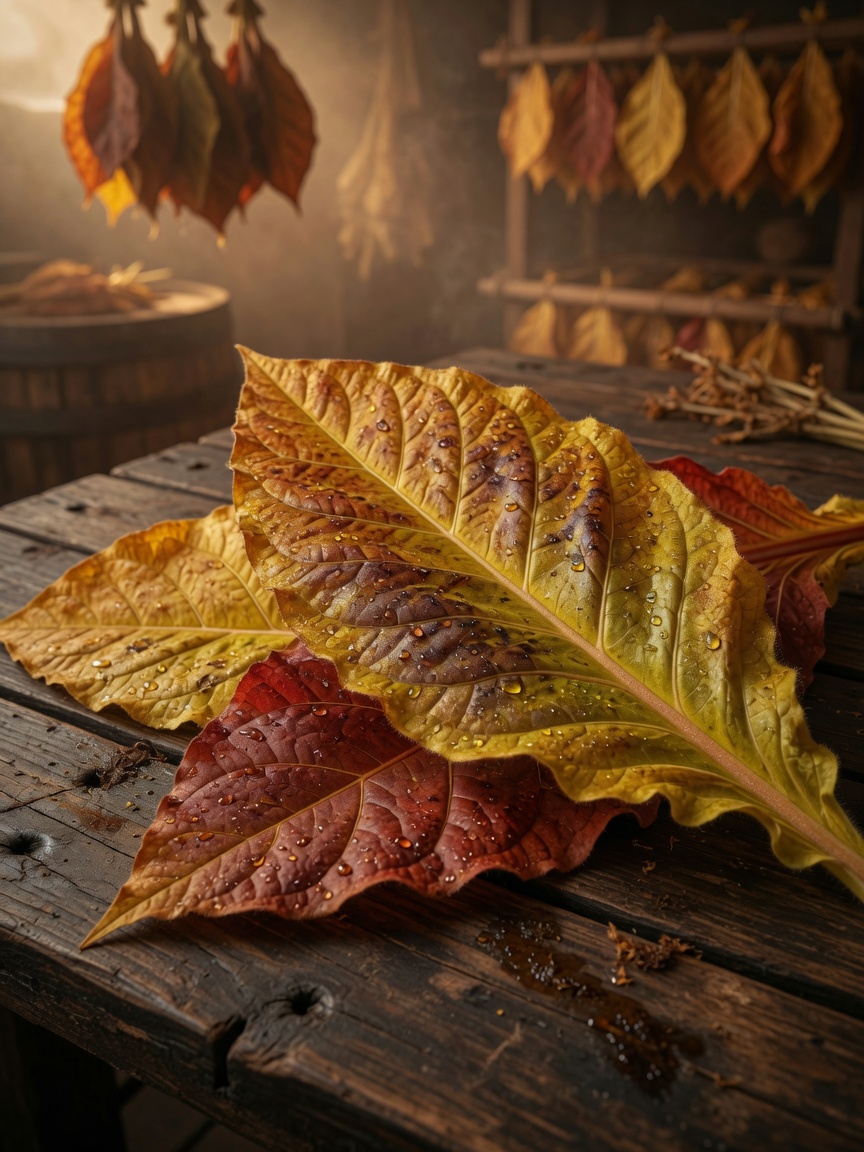
1. Where Grading Stands in the Industry Chain
\n\n
Simplifying the tobacco leaf path, it roughly goes:
\n\n
**Planting & Harvesting → Curing (flue-cured/air-cured/sun-cured, etc.) → Grading & Sorting → Redrying/Ordering/Fermentation or Aging → Blending & Formulation → Finished Product**
\n\n
The core function of grading is not to "give awards to leaves," but to:
\n\n
| Function | Explanation |
| ---------- | ------------- |
| **Turn natural variation into specifications** | The same field has differences in position, maturity, and curing outcome; grading separates mixed materials into describable grades |
| **Match procurement and pricing** | Contracts specify grade, position, moisture, damage limits, etc., not "feels pretty good" |
| **Serve blending and end use** | High-grade blends, regular filler, cigar wrapper/binder/filler — each has completely different tolerance for defects |
| **Control risk** | Mold, off-odor, severe green defects, foreign matter contamination — these are "can it enter the factory" issues, prioritized over "can it sell at a high price" |
\n
Without grading, the subsequent redrying, fermentation, and formulation would be like looking for a screw in a sand pile: not that good material can't be found, but it **can't be found consistently and repeatably**.
\n\n
\n
\n
2. First, Unify What the "Grading Dimensions" Mean
\n\n
Different standard systems use different terminology, but the dimensions most commonly evaluated on site are still those listed below. Think of it as a **multi-dimensional checklist**: extreme abnormality in any single dimension can "kick the batch out of use" or "downgrade its purpose."
\n\n
### 2.1 Core Four Dimensions: Color, Thickness, Oil, Integrity
\n\n
| Dimension | Field Definition | Questions It Answers | Typical Impact on Use |
| ----------- | ----------------- | --------------------- | ---------------------- |
| **Color** | Hue, depth, uniformity, presence of green/blemish/dullness | Is curing done right? Is the style leaning toward light-sweet or heavy-rich? Is the batch uneven? | Visual appeal (especially wrapper), aroma style clues, need for downgrading or reprocessing |
| **Thickness (Body)** | Leaf flesh density, single-leaf "substance feel," thickness grading | Is this leaf thin and floaty or thick and substantial? Better as "backbone" or "skin"? | Combustion & structure, filling efficiency, wrapper stretch and breakage risk |
| **Oil** | Oily sheen, gloss, resilience when rubbed (not lab-measured oil) | Is it dry? Is elasticity and aroma potential sufficient? | Hand feel, processing tolerance, empirical correlation with aging/fermentation performance |
| **Integrity** | Breaks, wormholes, tears, broken leaf percentage, midrib proportion | What's the usable leaf yield? Can it be laid out as whole leaf? What level of breakage is acceptable? | Utilization rate, labor cost, only for threshing/cutting or usable as whole leaf |
\n
### 2.2 Supporting Dimensions Almost Always Evaluated Together
\n\n
- \n
- **Position (Stalk Position)**: Lower, middle, upper (common in flue-cured systems); in cigar contexts there are also different "strength layers" for filler and wrapper leaves. Position often predicts nicotine impact, combustion, and aroma concentration trends better than "color alone." \n
- **Maturity**: Field ripeness manifests after curing in color purity, green/off notes, oil content, and tissue density. Maturity issues are often misread as "simple color problems." \n
- **Tissue Structure/Elasticity**: Loose or dense, spring-back after rubbing, fragility — affects processing tolerance and texture structure. \n
- **Variegation, Damage, Spots, Scald/Graying etc.**: Determine the extent of downgrading or outright rejection. \n
- **Moisture & Odor (Receiving Level)**: Uncontrolled moisture brings mold and processing risks; musty, off, or contaminated odors are often a "one-veto rejection." \n
\n
### 2.3 Rough Mapping from Indicators to "Industry Shorthand"
\n\n
- \n
- **Correct, uniform color**: visual plus; extremely high weight on wrapper. \n
- **Good body (moderate to substantial thickness)**: raw material "has substance"; too thick may also be harsh, stiff, poor stretch. \n
- **Good oil**: often co-occurs with elasticity and gloss in experienced narratives; dry leaves struggle to enter high-demand uses. \n
- **High integrity**: high whole-leaf utilization; broken leaves are not completely worthless, but usage shifts down and waste/dust management costs rise. \n
- **High damage/heavy variegation**: downgrade or reject; in blends can only be more cautiously "diluted in" or simply not used. \n
\n
These are **trend language**. Real blenders also layer in chemical testing (nicotine, sugar, chlorine, etc., depending on enterprise system) and test smoking; appearance grading is only the gateway, not the destination.
\n\n
\n
\n
3. Color: Most Visible, Most Easily Misread
\n\n
### 3.1 What Color Usually Refers to in Grading
\n\n
Color isn't just "yellow or not"; it's a set of observations:
\n\n
| Observation Point | Meaning |
| ------------------ | --------- |
| **Hue** | Lemon yellow, orange yellow, golden yellow, brownish, reddish brown, greenish yellow, etc. (terms vary across systems) |
| **Depth & Saturation** | Is it pale and washed out, or dark and murky |
| **Uniformity** | Is the whole leaf, whole handful, whole batch "patchy" or two-toned |
| **Abnormal Colors** | Green tinge, graying, scald, steamed appearance, mold spots, bruising, etc. |
\n
Lighting matters: side light, standard light sources, and overcast natural light all shift the "true color" judgment of the same leaf. Trained graders standardize observation conditions instead of "going by feel" under colored lights.
\n\n
### 3.2 Different Curing Types, Different Color Semantics
\n\n
- \n
- **Flue-cured tobacco**: Emphasis on positive hues like "golden to orange"; green tinge and graying are commonly cited as defects. \n
- **Air-cured/Sun-cured tobacco**: Deeper, browner color ranges are permitted or even desired; the "golden aesthetic" of flue-cured cannot be forced onto them. \n
- **Cigar wrapper leaf**: Brown, reddish-brown, uniform "mature fermented color" is often preferred; incompletely fermented "raw, green, uncured" appearance is treated cautiously. \n
\n
**Conclusion: Color standards are subordinate to product type.** Talking about "good color" without reference to curing method and intended use turns grading into a beauty contest.
\n\n
### 3.3 Reasonable Correlations Between Color and Quality (and Their Breaking Points)
\n\n
**Reasonable correlations:**
\n- \n
- Uniform, pure color often suggests well-controlled curing and good batch consistency; \n
- Green tinge is often associated with insufficient maturity or curing issues, raising narratives of off-flavor and harshness; \n
- Excessively scorched, dull, dark color may accompany decreased oil and tissue damage. \n
\n
**Breaking points (must remember):**
\n- \n
- Good color ≠ good aroma; \n
- Deep color ≠ necessarily more "premium" or stronger; \n
- Individual leaves looking good while the whole batch is inconsistent is still a disaster for factories (uniformity failure). \n
\n
### 3.4 Common Misjudgments in the Color Dimension
\n\n
1. Using phone beauty filters or warm lighting to judge grades.
\n2. Treating "dark color" as automatically "rich and premium."
\n3. Ignoring position: upper and lower leaves have different "normal colors" on entirely different reference lines.
\n4. Only looking at the front side, ignoring the back and vein-area blemishes.
\n\n
\n
\n
4. Thickness (Body): A Dimension Where Hand Matters More Than Eye
\n\n
### 4.1 What "Thickness" Is Often Called in the Industry
\n\n
In Chinese raw material contexts, **body** is a frequently used term: it refers to whether the leaf flesh is substantial and "has substance," related to but not identical to measuring millimeters with calipers. On site, evaluation relies more on:
\n\n
- \n
- Rubbing the leaf, folding it, holding it up to light to see the flesh; \n
- Comparing within the same position (using lower-leaf standards on upper leaves leads to misjudgment); \n
- Combining midrib thickness with leaf flesh and vein ratios. \n
\n
### 4.2 General Thickness Trends and Uses
\n\n
| Tendency | Common Source Clues | Typical Use Logic |
| ---------- | --------------------- | ------------------- |
| **Rather thin** | Lower leaves, undernourished, too dense/weak light, abnormal curing, etc. | Filler, some mild blends; as wrapper may tear or feel weak |
| **Medium/Moderate** | Common target zone for well-ripened middle leaves (varies by variety) | Most "useful range" in blending |
| **Rather thick** | Upper leaves, wide spacing/high nitrogen, strong topping | Enhances strength; may also increase harshness and reduce elasticity |
\n
For **cigarette blends**, thickness affects cut filler structure, filling value, and combustion.
\nFor **cigar wrapper**, too thick may be hard to roll, prone to cracking, and stiff; too thin increases breakage rate.
\nFor **filler**, different thickness layers are often intentionally combined to balance combustion and strength.
\n\n
### 4.3 Factory Logic for Thickness Selection
\n\n
Factories rarely say "only thick leaves" or "only thin leaves" in isolation; instead they ask:
\n\n
- \n
- Does this thickness match the **contract position and grade**? \n
- Is it matched with oil and elasticity (thick & dry vs. thick & oily are completely different things)? \n
- Is there severe variation in thickness within the batch? \n
\n
**Inconsistent thickness** is often more troublesome than "uniformly slightly thin": blends are designed around average values, but if the incoming material is "half brick, half tissue paper," consistency collapses.
\n\n
\n
\n
5. Oil: Integrated Hand Feel of Moisture, Elasticity, and Durability
\n\n
### 5.1 Oil Is Not "a Layer of Cooking Oil on the Leaf"
\n\n
In the grading context, oil is a **composite impression of visual gloss + tactile moistness + rubbing resilience**. It relates to leaf cell contents, curing moisture retention, and tissue structure, but it is **sensory evaluation language**, not a food oil content label.
\n\n
Leaves with good oil are commonly described as:
\n- \n
- Livelier color, not dull and gray; \n
- Moist hand feel, moderately supple; \n
- Less likely to "crumble to powder" during processing. \n
\n
Leaves with poor oil are more prone to: dryness, fragility, dull luster — quickly excluded from high-demand uses like premium wrapper.
\n\n
### 5.2 Reading Oil in Combination with Color and Thickness
\n\n
Grading experts rarely score single dimensions; they read combinations:
\n\n
| Combination | Common Interpretation (Trend) |
| ------------- | ------------------------------ |
| Good color + moderate body + good oil | High utility potential; still depends on integrity and batch |
| Deep color + very thick + poor oil | Possibly dry-thick, poor processability; be cautious treating as "premium material" |
| Light color + rather thin + fair oil | Could serve as mild filler, but limited strength |
| Good oil but heavy damage | Quality potential exists, but utilization rate and cost may be issues |
\n
### 5.3 How Factories "Select for Oil"
\n\n
- \n
- **Sample rubbing**: standardize pressure and leaf area; avoid only rubbing the tip or only the midrib area. \n
- **Compare to standard samples**: enterprises maintain grade standards rather than relying purely on the day's mood. \n
- **Combine with moisture**: too dry falsely appears "low oil"; too damp falsely appears "oily" and masks mold risk. \n
\n
\n
\n
6. Integrity: The Ruler of Utilization Rate and Use Boundaries
\n\n
### 6.1 What Defects Does Integrity Include?
\n\n
- \n
- Mechanical damage, tearing, folding injuries; \n
- Wormholes, disease spot damage; \n
- Broken leaf, powder, fines; \n
- Midrib too thick or too high in proportion (reducing usable leaf flesh); \n
- Over-trimming or improper tying causing secondary damage. \n
\n
Integrity directly determines:
\n- \n
- **Leaf yield** (usable area per unit weight); \n
- **Labor sorting costs**; \n
- **Whether it can only enter threshing/redrying/cutting rather than whole-leaf use**. \n
\n
### 6.2 "Are Broken Leaves Always Bad?"
\n\n
Not necessarily.
\n\n
- \n
- For **cigarettes**, after threshing and redrying, much of the value lies in leaf chemistry and cleanliness, not whole-leaf appearance. \n
- For **cigar wrapper**, integrity is critical: holes, thin spots, cracks can ruin a wrapper leaf. \n
- For **filler**, a certain degree of breakage is acceptable, but mold, green/off, and foreign matter must still be controlled. \n
\n
So the standard for integrity **always follows the intended use**.
\n\n
### 6.3 Factory Integrity Strategy
\n\n
| Scenario | Common Treatment |
| ---------- | ----------------- |
| Minor edge damage, main use unaffected | Downgrade or price discount then use |
| Moderate damage but leaf flesh usable | Redirect to filler/mid-low blend, or re-sort |
| Severe breakage, powder, contamination | Reject or strictly limited use |
| Foreign matter (strings, plastic, metal, stones) | Quality incident-level handling; reject or clean |
\n
Foreign matter and mold typically take priority over minor damage.
\n\n
\n
\n
7. How Standards Become "Executable Grades"
\n\n
### 7.1 Common Combination Approach (Popular Science Level)
\n\n
Most flue-cured grading systems combine the following elements into grade codes or text grades:
\n\n
1. **Position** (lower/middle/upper or finer groups)
\n2. **Color/Color Group**
\n3. **Length or Quality Grade** (length often as one appearance specification)
\n4. **Damage and Variegation Allowance**
\n5. **Maturity and Body Composite Quality** (weight varies across standards)
\n\n
Cigar leaf grading more often follows:
\n- \n
- **Use**: wrapper, binder, filler; \n
- **Visual**: color uniformity, fine midrib, few holes; \n
- **Tactile**: oil, elasticity, thickness; \n
- **Combustion & Strength Profile**: especially for filler layering. \n
\n
Enterprises also add **internal control standards**: stricter than national standards on damage rates, green leaf rates, moisture, sand content, odor veto, etc.
\n\n
### 7.2 Standard Text vs. Field Execution
\n\n
| Level | Role | Limitation |
| ------- | ------ | ------------ |
| National/Industry Standard | Common trade language, arbitration reference | Cannot cover all growing regions and product types |
| Contract & Sample | Turns "standard" into physically verifiable form | Sample preservation and lighting affect reproducibility |
| Enterprise Control & Training | Ensures production line stability | May create insular "own-eye-only" judgment |
| Instrument Assistance (colorimeter, NIR, etc.) | Improves consistency, reduces personal bias | Cannot fully replace mold odor and foreign matter checks |
\n
**The essence of grading is: turning differences into repeatable decisions within cost constraints.**
\n\n
### 7.3 Why Just Memorizing Clauses Isn't Enough
\n\n
The clause says "damage not to exceed x%", but on site you still need to judge:
\n\n
- \n
- How to measure and sample damage; \n
- How to handle mixed batches; \n
- Whether borderline samples go up or down; \n
- When color is just right but oil is insufficient, does the intended use still hold? \n
\n
This is why **selection logic** matters more than "grade names."
\n\n
\n
\n
8. Factory Selection Logic: From Gate to Blend
\n\n
### 8.1 Receiving Inspection: First Ask "Can We Accept It?" Then "At What Price?"
\n\n
Priority is typically:
\n\n
1. **Safety & Hygiene Baseline**: mold, severe off-odor, contamination, live pests, unacceptable foreign matter;
\n2. **Identity Authenticity**: adulteration, mixed position, inferior substituting for superior, abnormal moisture;
\n3. **Specification Compliance**: position, grade, color group, length, damage match contract/standard sample;
\n4. **Batch Uniformity**: random multi-point sampling, not just the top layer.
\n\n
Typical actions for non-conforming deliveries: rejection, return, downgrade renegotiation, conditional acceptance.
\n\n
### 8.2 Initial Sorting: Routing by Use
\n\n
| Flow | Values More | Cannot Tolerate |
| ------ | ------------- | ----------------- |
| High-demand appearance use (wrapper, display material) | Uniform color, integrity, oil & elasticity, fine midrib | Holes, variegation, thin spots, thick veins |
| Structure/Strength blends | Body, pure position, stable chemistry & test smoking | Mixed position, green/off, abnormal harshness |
| Regular filler | Clean, combustible, low cost | Mold, foreign matter, excessive fines |
| Reprocess/Reclaim | Potential but moisture or condition off | Already moldy or contaminated |
\n
### 8.3 Rejection Priority (On-Site Decision Table)
\n\n
| Issue | Common Action | Reason |
| ------- | -------------- | -------- |
| Mold, musty odor | Reject / batch risk review | Contamination & safety |
| Foreign matter | Return or clean | Equipment & quality risk |
| Severe green tinge, off-character | Downgrade or reject | Sensory defect hard to fully mask |
| Severe damage but clean | Change use / downgrade | May still have chemical value |
| Minor color difference, edge damage | Price & use adjustment | Cost-quality balance |
| Low oil but clean | Restricted to low-demand blends | Processing & style limited |
\n
### 8.4 Sampling: What Factories Really Fear Is "Non-Uniformity"
\n\n
Factories fear:
\n- \n
- Top layer all good middle-position leaves, bottom layer all green broken leaves; \n
- Mixed positions causing nicotine and combustion fluctuation; \n
- Localized high moisture forming mold "landmines." \n
\n
Therefore sampling emphasizes:
\n- \n
- **Multi-point, multi-layer, multi-bale**; \n
- **Record defect type proportions**, not just "generally OK"; \n
- **Tighten borderline batches**, standard frequency for stable suppliers. \n
\n
### 8.5 Blend Perspective: Not "All Highest Grade"
\n\n
High-grade leaves are scarce and expensive. Modern leaf blending logic is typically:
\n- \n
- Use **high-grade** leaves to stabilize the key structure of aroma and body; \n
- Use **mid-grade** leaves to contribute volume, combustion balance, and cost; \n
- Use **specific low-grade or byproducts** (within compliance and quality limits) for filler and cost management. \n
\n
**The goal of selection is "what role does this batch play in the blend," not "can this leaf win a beauty contest."**
\n\n
### 8.6 Three Truths About Cost-Quality Trade-offs
\n\n
1. Paying a 50% premium for a 5% appearance improvement only makes sense for products where appearance is critical.
\n2. Raw material that looks slightly worse but is extremely stable in batch may have higher production line efficiency than "good-looking but inconsistent" material.
\n3. Downgrade must be documented: who approved, which blend, maximum ratio — otherwise "temporary use" becomes systematic drift.
\n\n
\n
\n
9. Quick Reference: Dimensions x Field Actions
\n\n
| Dimension | Quick Look/Feel | Factory's Question | Handling |
| ----------- | ---------------- | -------------------- | ---------- |
| Color | Check hue, uniformity, green/off under standard light | Does it match contract color group? | Off-color -> downgrade/restrict; patchy -> grade mixing |
| Thickness | Fold and check against light, compare same position | Does body support intended use? | Too thin/thick -> change use |
| Oil | Gloss + rubbing moistness and elasticity | Is it dry? Will it break easily? | Dry -> low-demand uses or reject |
| Integrity | Holes, tears, broken leaf rate | Is leaf yield worth labor cost? | Broken -> filler/threshing; torn -> exclude from wrapper |
| Moisture & Odor | Hand feel + smell | Is it safe? Stable? | Abnormal -> veto or re-dry |
| Position Purity | Vein pattern, leaf shape, thickness distribution | Is it mixed ruining the blend? | Mixed -> re-sort or downgrade |
\n
\n
\n
10. Common Misconceptions
\n\n
1. **"Darker color is always better."** Depends on type and use. Flue-cured vs. cigar, wrapper vs. filler — "good color" is not on the same axis.
\n2. **"Thicker leaves are more premium."** Thick can mean substantial, but also harsh and hard to process. Wrapper is not "the thicker the better."
\n3. **"Good oil = definitely high aroma."** Oil is an important positive signal, but aroma is also affected by variety, growing region, fermentation/aging, and combustion chemistry.
\n4. **"Broken leaves are always bad."** Breakage affects utilization, but doesn't mean chemical value is zero. But broken AND dirty, or broken AND moldy, is different.
\n5. **"Higher grade = healthier/reduced harm."** Grading and health have no such equivalence. This is raw material language, not medical risk language.
\n6. **"National standards eliminate disputes."** Borderline samples, sampling methods, and contract terms keep disputes alive. Standards reduce them, not eliminate them.
\n7. **"Factories only buy the best-looking leaves."** Factories buy specifications that match use and are stably available. Good-looking but unstable is not always wanted.
\n8. **"Knowing grade codes means you can grade."** Codes are the result; understanding dimensions and use decisions is the skill.
\n\n
\n
\n
11. Wrapping Up the Logic in One Chain
\n\n
\n**Color** answers "does it look like this type of tobacco and is it uniform," **thickness** answers "does it have substance and is it suitable as skeleton or skin," **oil** answers "is it moist and durable," **integrity** answers "can it be used as whole leaf." On top of this, factories first check **mold, foreign matter, and moisture**, then **batch uniformity and contract compliance**, then **route by blend role** — not a beauty contest for every leaf.
\n
Three practical tips:
\n- \n
- When you see "high-grade / ample oil / heavy damage" in industry articles, translate them back to this framework, not into "good/bad/toxic/non-toxic." \n
- When comparing products, first ask about curing type and use, then about color depth. \n
- Any claim that "a certain grade is safer" should be met with skepticism: the grading system does not bear that proof. \n
\n
\n
\n
12. Health and Position Statement
\n\n
Tobacco leaf grading is the technical language of agricultural raw materials and industrial procurement. It:
\n- \n
- **Does not** prove that higher-grade products are less hazardous; \n
- **Does not** constitute encouragement to smoke; \n
- **Does not** replace medical cessation advice or official standards. \n
\n
The public health consensus remains: **smoking is harmful to health.** For those seeking to move away from combustible tobacco, evidence-based cessation support should be sought.
\n\n
\n
\n
Conclusion
\n\n
If "Tobacco Leaf Grading Standards and Selection Logic" were condensed into three steps:
\n\n
1. **Use a multi-dimensional checklist**: color, thickness, oil, integrity, plus position, maturity, and defects;
\n2. **Use a common language to assign grades**: standards, standard samples, and contracts turn natural variation into tradeable specifications;
\n3. **Use factory purpose to select**: first safety and compliance, then uniformity, then blend role and cost.
\n\n
Understanding this logic lets you understand the raw material market and stop mistaking "golden, thick, oily" for a health endorsement.
\n\n
\n
\n
**Disclaimer**: This article is a popular science introduction to tobacco leaf grading for basic understanding. It does not constitute official certification, procurement acceptance criteria, or medical advice. Smoking is harmful to health.
\n